Borehole Costs in South Africa 2026, and the Registration Myth
By EV Cost Calculator Team · Published · Last updated
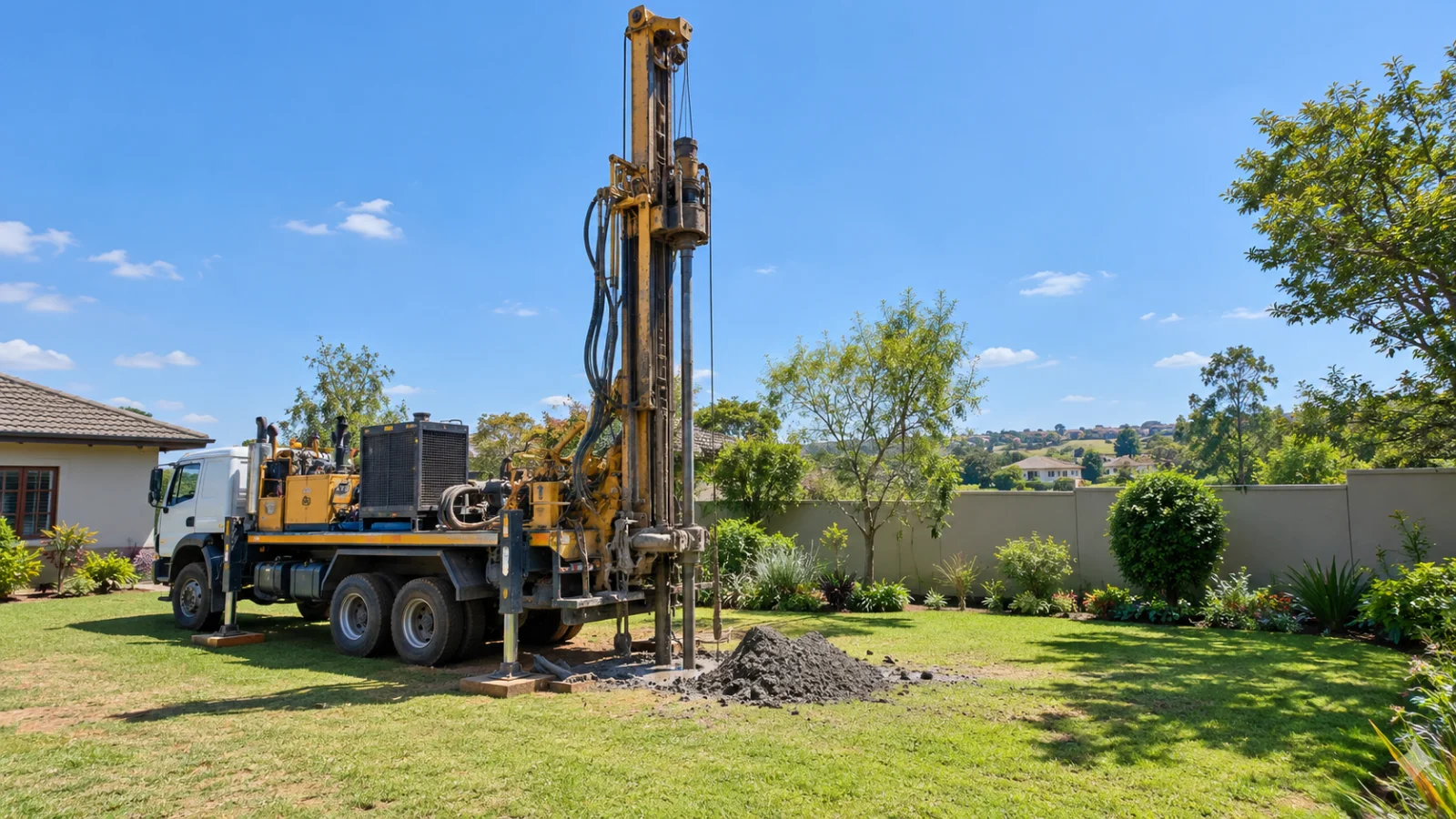
Published borehole drilling rates in South Africa range from R290 to R2,500 per metre, and complete systems from R40,000 to R170,000. That spread is not a mistake. It reflects geology, access and a market with no standard pricing. Here is how to read a quote, and the registration rule that most websites get wrong.
First, the legal question everyone gets wrong
You have probably read that you must register your borehole with the Department of Water and Sanitation. For a normal household, that is not correct.
The Department published a notice on 24 April 2026 calling unregistered water users to register within 90 days, as covered by law firm Tabacks. That notice generated a wave of alarmed coverage and a lot of vendor pages warning of penalties.
The Department then confirmed in writing to the Organisation Undoing Tax Abuse that households using borehole water for reasonable domestic purposes are exempt under Schedule 1 of the National Water Act. Per OUTA, such users cannot be penalised or prosecuted for failing to register, and there is no prescribed volume threshold for domestic groundwater use. The Citizen reported the same confirmation.
So ignore any site quoting a threshold of 25 cubic metres a day or 25 litres per person per day as the trigger for registration. Those figures conflict with the Department's own stated position.
What does still apply. Municipal bylaws are separate from national law. Tshwane prohibits any direct connection between a borehole system and the municipal reticulation network, which exists to stop contamination flowing back into the public supply. Cape Town requires registration and signage. Check your own municipality before drilling, and never cross-connect to the mains.
What drilling actually costs
The published per-metre rates disagree sharply, and you should know that before anyone quotes you.
| Source | Rate per metre |
|---|---|
| Drillbuilders 2026 index across 14 cities | R290 to R750 |
| Borehole Hub, Gauteng | R380 to R450 |
| Enviroleg | R500 to R1,500 |
Rates as published by OurPower, Lekker Trade and Borehole Hub. The highest published figures come from a drilling rig manufacturer rather than a South African contractor, which is why they sit well above local quotes and are not included above.
On total project cost, Borehole Hub puts a full system at R40,000 to R170,000. That range covers everything from a shallow hole with a basic pump to a deep hole with filtration and a storage tank.
Other line items worth budgeting separately:
- Geophysical survey, roughly R3,500 to R8,000. This is where a hydrogeologist tells you where to drill.
- Yield test, roughly R1,500 to R5,000. This tells you how much water the hole can actually sustain.
- Water quality testing. We could not verify current prices. Get it quoted, and do not skip it.
The part the quotes do not mention
Drilling can fail. You can pay for a hole that produces nothing, or produces water too saline or too contaminated to use without expensive treatment.
This is not a fringe risk. In October 2026 The Citizen ran a report headlined around R750 million spent on boreholes with many not producing water. That was about public projects rather than households, but the underlying geology does not care who is paying.
Ask any contractor directly what happens if the hole is dry. Get the answer in writing. A contractor who will not put that in a quote is telling you something.
Does a borehole save money?
Usually less than people expect, and that is the wrong reason to drill.
Take a R70,000 system producing 500 litres a day for 10 years. That is 1,825 kilolitres, which works out to about R38 per kilolitre in capital cost alone, before electricity for the pump, before maintenance and before any treatment.
Compare that to Johannesburg's 2026/27 water tariff. The band from 6 to 10 kilolitres a month costs R33.57 per kilolitre on a conventional meter. The top band, over 50 kilolitres, costs R100.40.
So a borehole only beats municipal water on price if you are a heavy user sitting in the upper tariff bands. For an average household paying lower-band rates, the capital cost per kilolitre is comparable to simply buying the water, and then you still pay to pump it.
That calculation is illustrative and rests on the stated assumptions rather than measured data. Run your own numbers against your actual bill with our water cost calculator.
The real case for a borehole is resilience, not savings. It is independent of the municipal network, which is the whole point when that network fails 22 times in two weeks. Judge it as insurance, not as an investment.
Borehole water is not automatically drinking water
Groundwater can carry nitrates, heavy metals, bacteria or salinity depending on what is in the ground and what is leaking into it nearby. Failing sewage infrastructure is a documented groundwater risk.
Test before you drink, and test periodically afterwards rather than once. If you intend to use borehole water for drinking, budget for treatment as part of the project rather than as an afterthought. Reverse osmosis systems retail from around R2,950, and multi-stage filter housings from around R2,200, per Mercury Build It.
A sensible order of spending
- Storage first. A vertical tank is the cheapest resilience per rand and solves the most common problem, which is a short outage.
- Pressure second, if weak gravity flow is not acceptable to you.
- Borehole third, and only if you have the budget, the space, reasonable prospects of water and a tolerance for the risk of a dry hole.
Most households that start at step three and skip step one end up spending more for less reliability.
Frequently asked questions
Do I need to register a borehole in South Africa?
Not for normal household use. The Department of Water and Sanitation confirmed in writing in July 2026 that households using borehole water for reasonable domestic purposes are exempt under Schedule 1 of the National Water Act, and cannot be penalised for not registering. Municipal bylaws are separate and may still apply.
How much does it cost to drill a borehole in South Africa?
Published rates range from R290 to R1,500 per metre depending on the source and location, with complete systems quoted at R40,000 to R170,000. Budget separately for a geophysical survey of R3,500 to R8,000 and a yield test of R1,500 to R5,000.
What happens if a borehole does not find water?
You can still be liable for the drilling cost. Ask any contractor what their policy is on a dry hole and get the answer in writing before work starts.
Is a borehole cheaper than municipal water?
Often not. A R70,000 system producing 500 litres a day for 10 years works out to about R38 per kilolitre in capital cost alone, against R33.57 per kilolitre in Johannesburg's 6 to 10 kilolitre band. It only wins clearly for heavy users in the upper tariff bands.
Can you drink borehole water?
Only after testing. Groundwater can carry nitrates, heavy metals, bacteria or salinity, and failing sewage infrastructure is a documented groundwater contamination risk. Test before drinking and retest periodically.