Electric Car Running Costs in South Africa (2026)
By EV Cost Calculator Team · Published · Last updated
Electric Car Running Costs vs Petrol in South Africa: 2026 Comparison
Filling a 54-litre petrol tank in South Africa now costs over R1,350. Charging an EV battery to the same range costs between R100 and R400, depending on where and how you charge.
That gap explains why running cost comparisons have become the deciding factor for many South African drivers considering an electric vehicle. This guide breaks down the actual rand-per-kilometre costs for EVs and petrol cars, covers home and public charging expenses, and shows which drivers benefit most from making the switch.
How much does it cost per kilometre to run an EV vs petrol car
Electric cars cost significantly less to run than petrol vehicles in South Africa. At home charging rates averaging R3/kWh, an EV typically costs between R0.45 and R0.80 per kilometre. Petrol vehicles, by contrast, commonly run between R1.80 and R2.50 per kilometre at current fuel prices above R25 per litre.
That difference translates to savings of 50–70% on fuel costs alone. For a driver covering 1,500 km per month, the gap between EV and petrol running costs can exceed R2,000 monthly.
EV running cost per kilometre in South Africa
Calculating EV running cost involves two numbers: your electricity tariff (measured in R/kWh, or rands per kilowatt-hour) and your vehicle's efficiency (measured in kWh/100km, which tells you how much electricity the car uses to travel 100 kilometres). Multiply the tariff by the efficiency, then divide by 100.
So if you pay R3.20/kWh at home and drive a car with an efficiency of 14 kWh/100km, your running cost works out to roughly R0.45 per kilometre. Public charging stations charge more, typically R5.50 to R7.50/kWh for DC fast charging, which pushes costs closer to R1.00–R1.40 per kilometre.
Petrol running cost per kilometre in South Africa
Petrol running costs follow a similar calculation: divide the fuel price per litre by your car's fuel economy in km/L. With petrol prices consistently above R25 per litre throughout 2025, even a fuel-efficient car averaging 12 km/L costs around R2.10 per kilometre.
Less efficient vehicles like SUVs, older models, or cars driven in heavy traffic can easily exceed R2.50 per kilometre. And unlike electricity tariffs, which remain relatively stable month to month, petrol prices fluctuate based on international oil prices and the rand exchange rate.
Monthly and annual savings comparison
The per-kilometre difference adds up quickly. Here's what a driver covering 1,500 km per month might expect:
| Cost factor | Electric vehicle | Petrol vehicle |
|---|---|---|
| Cost per km | R0.55 | R2.20 |
| Monthly fuel/energy cost | R825 | R3,300 |
| Annual fuel/energy cost | R9,900 | R39,600 |
| Annual savings | R29,700 | - |
Your actual savings depend on your specific vehicle, electricity tariff, and driving patterns. A driver with solar panels at home or access to off-peak electricity rates would save even more.
EV charging costs for home and public stations
Where you charge determines how much you pay. Most EV owners in South Africa charge primarily at home, where costs are lowest, and use public stations for longer trips or occasional top-ups when away from home.
Home charging costs using Eskom tariffs
Home charging is the most affordable option for daily driving. Provincial electricity tariffs in South Africa average around R3/kWh for residential customers, though the exact rate varies by municipality and whether you're on prepaid or postpaid billing.
Charging a 60 kWh battery from 20% to 80%, which is a typical daily charge pattern, uses about 36 kWh of electricity. At average home rates, that works out to roughly R108. Most EV owners simply plug in overnight and wake up to a full charge, ready for the day.
Tip: Check your municipal tariff on your electricity bill or use EV Cost Calculator's provincial tariff selector to see accurate charging costs for your area.
Public fast charging at GridCars and other networks
South Africa's public charging network continues to expand through providers like GridCars, Audi Charge, and BMW ChargeNow. At public stations, you'll encounter two main charging types:
- AC charging: Slower speeds (7–22 kW), typically R4.50–R5.50/kWh, suitable for longer stops like shopping or dining
- DC fast charging: Much faster speeds (50–150 kW), typically R7.00–R7.50/kWh, ideal for road trips when you want to add range quickly
While public charging costs more than home charging, it enables long-distance travel and provides convenient top-ups when you're away from home for extended periods.
Saving with time-of-use electricity rates
Some municipalities offer time-of-use tariffs with cheaper off-peak rates, typically between 22:00 and 06:00. If your meter supports this billing structure, scheduling your EV to charge overnight can reduce costs by 20–40% compared to peak-hour charging.
Even on standard tariffs, overnight charging avoids adding to your household's peak electricity demand during expensive evening hours when everyone is cooking and running appliances.
Petrol costs at current South African fuel prices
Petrol prices in South Africa are regulated monthly by the Department of Mineral Resources and Energy. Throughout 2025, inland 95 unleaded has remained above R25 per litre, with coastal prices slightly lower due to transport cost differences.
Unlike electricity, where you can choose when to charge and potentially access cheaper rates, petrol costs are fixed at the pump. The only ways to reduce petrol expenses are to drive less, drive more efficiently, or choose a more fuel-efficient vehicle. There's no equivalent to off-peak pricing or home generation.
Running cost comparison for popular EVs in South Africa
Real-world running costs vary by vehicle. Here's how four popular EVs available in South Africa compare, assuming home charging at R3.20/kWh:
| Model | Efficiency (kWh/100km) | Cost per km | Starting price |
|---|---|---|---|
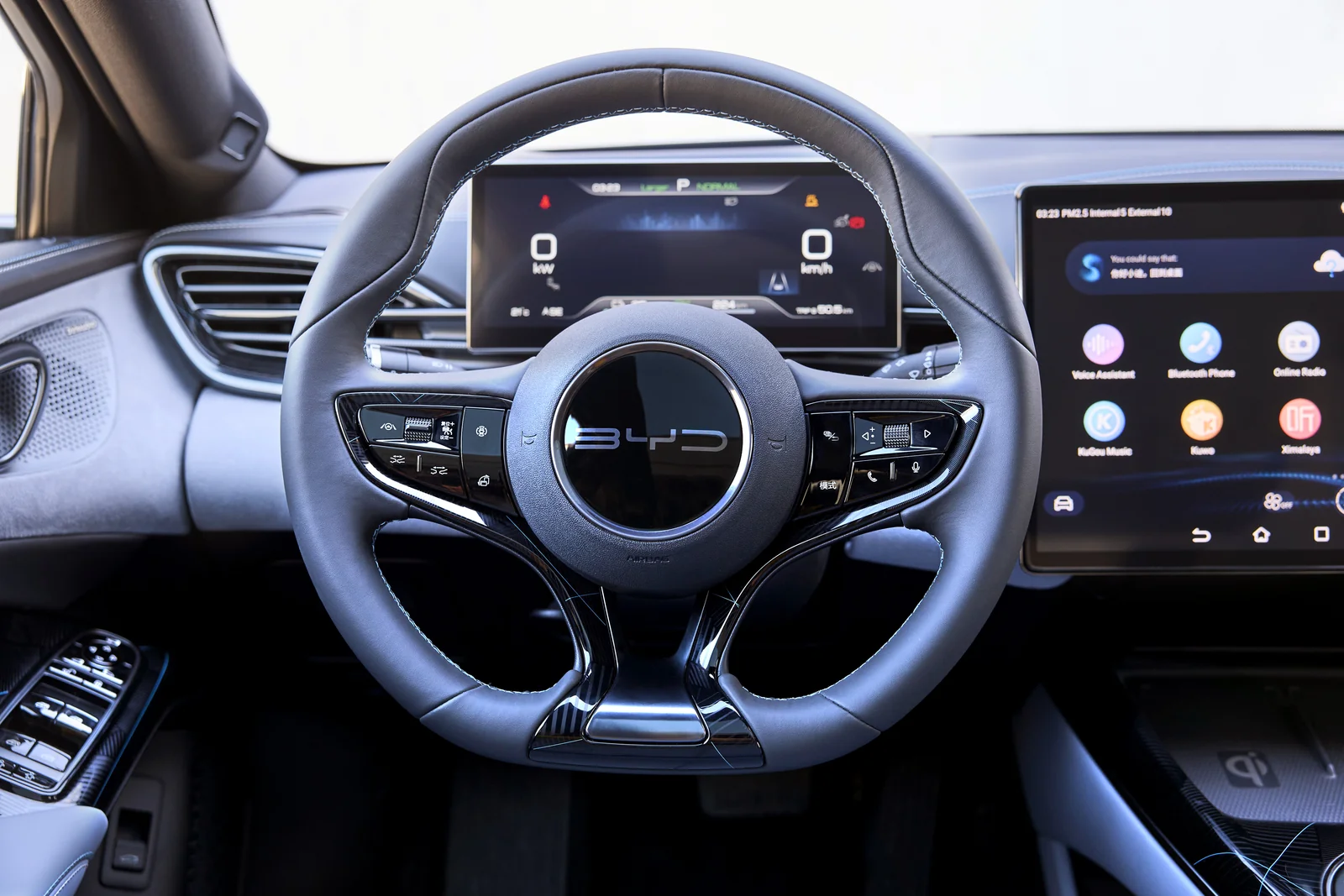
| BYD Dolphin | 14.0 | R0.45 | ~R580,000 |
| Volvo EX30 | 15.5 | R0.50 | ~R750,000 |
| BMW iX3 | 18.5 | R0.59 | ~R1,200,000 |
| Mercedes-Benz EQA | 17.5 | R0.56 | ~R1,100,000 |
BYD Dolphin
The BYD Dolphin represents one of South Africa's most affordable EV options, with pricing starting under R600,000. Its compact hatchback design and excellent efficiency make it particularly cost-effective for urban commuters. At home charging rates, running costs stay under R0.50 per kilometre.
Volvo EX30
Volvo's compact SUV combines premium features with competitive efficiency. The EX30 appeals to buyers wanting a recognised brand with practical running costs, sitting in the space between entry-level and luxury segments. Efficiency remains strong for an SUV at 15.5 kWh/100km.
BMW iX3
The iX3 offers a mid-size SUV with strong range and the practicality families expect. While less efficient than smaller EVs due to its size and weight, it still costs roughly a quarter of what a comparable petrol SUV would cost to run per kilometre.
Mercedes-Benz EQA
Mercedes-Benz's compact luxury SUV targets buyers prioritising comfort and brand prestige. Running costs remain substantially lower than petrol equivalents, even at the premium end of the market where efficiency typically takes a back seat to performance.
EV vs petrol maintenance and servicing costs
Running costs extend beyond fuel and electricity. EVs typically cost less to maintain because they have fewer components that wear out or require regular servicing.
Why electric cars cost less to maintain
Electric vehicles have a simpler mechanical design than petrol cars. The differences show up in several areas:
- Fewer moving parts: No engine, transmission, or exhaust system means fewer things to service or replace over time
- No oil changes: EVs don't use engine oil, eliminating one of the most frequent and recurring service items
- Regenerative braking: The electric motor slows the car when you lift off the accelerator, which reduces brake pad and disc wear significantly
- Longer service intervals: Many EVs only require annual check-ups rather than services every 10,000–15,000 km
Typical petrol car service costs
Petrol vehicles require regular oil changes, air filter replacements, spark plug changes, and eventually more expensive items like timing belt replacements and exhaust repairs. Over a typical ownership period of five to seven years, maintenance costs accumulate to several thousand rand annually, adding to the total cost of running the vehicle.
How provincial electricity tariffs affect charging costs
Your charging costs depend partly on where you live. Eskom sets baseline tariffs, but municipalities add their own margins, creating variation across provinces and cities.
Several factors influence your home tariff:
- Municipality pricing: Different municipalities charge different rates for the same electricity
- Billing type: Prepaid and postpaid customers often pay different rates
- Usage tier: Higher monthly usage sometimes triggers higher per-unit rates
- Time-of-use availability: Some areas offer cheaper off-peak rates for overnight charging
Select your province on EV Cost Calculator to see charging costs based on your local tariff rather than national averages. The difference between provinces can amount to R0.10–R0.20 per kilometre in running costs.
When EV running cost savings break even
EVs typically cost more upfront than equivalent petrol vehicles. The question then becomes: when do fuel savings offset that price difference?
The break-even point depends on several factors. High-mileage drivers reach it faster because they accumulate more fuel savings each year. Drivers with access to cheap home charging, especially those with solar panels, accelerate the timeline further.
For many drivers covering 15,000–20,000 km annually, break-even typically occurs within three to five years of ownership. As EV prices continue to decrease with more affordable models entering the South African market, that period shortens.
Who saves the most by switching to an electric car
EVs don't suit everyone equally. Some drivers benefit more than others based on their circumstances and driving patterns:
- High-mileage commuters: More kilometres driven means more fuel savings accumulated each year
- Urban drivers: Stop-start traffic suits EV efficiency, and regenerative braking maximises range in city conditions
- Households with home charging access: A garage or dedicated parking spot with power access enables the lowest charging costs
- Fleet managers: Predictable running costs and reduced maintenance simplify budgeting and total cost of ownership calculations
- Drivers with solar installations: Charging from rooftop solar during daylight hours can reduce electricity costs to near zero
Drivers who travel long distances on highways frequently, or who lack access to home charging, may find the savings less compelling.
Book an EV test drive to experience real savings
Numbers tell part of the story, but driving an EV reveals the rest. A test drive helps you understand how regenerative braking feels, how the efficiency display works, and whether the driving experience suits your preferences.
Dealerships for BYD, BMW, Mercedes-Benz, Volvo, and other brands offer EV test drives across South Africa. Many drivers find that experiencing instant torque and quiet operation firsthand clarifies whether an EV fits their lifestyle better than any spreadsheet could.
Calculate your personal EV vs petrol running costs
Running costs depend on your specific situation: the vehicle you choose, your province's electricity tariff, and how many kilometres you drive. National averages provide useful context, but personalised calculations give you numbers you can actually plan around.
Select an EV on EV Cost Calculator to see charging costs, range estimates, and charging times based on real South African electricity tariffs. You can adjust the charge range from a starting percentage to an ending percentage, such as 20% to 80%, to match how you'd actually charge day to day.
FAQs about electric car running costs in South Africa
What happens to EV charging costs during load shedding?
During load shedding, grid electricity is unavailable, so home charging pauses until power returns. Many EV owners schedule charging for overnight hours when load shedding is less common. Some households with solar and battery storage maintain charging capability even during outages.
How does highway driving affect EV running costs?
Highway driving at sustained high speeds reduces EV efficiency because there's less opportunity for regenerative braking and greater air resistance at speed. Running costs per kilometre typically increase by 15–25% on long highway trips compared to urban driving patterns.
Can solar panels reduce EV charging costs in South Africa?
Yes, charging your EV from rooftop solar during daylight hours can reduce or eliminate electricity costs entirely. South Africa's abundant sunshine makes solar-equipped households particularly well-suited to maximising EV savings, especially for drivers who can charge during the day.
What is the 80% charging rule for electric cars?
The 80% rule suggests charging your EV battery to 80% for daily use rather than 100%. Limiting the charge level helps preserve long-term battery health by reducing stress on the cells. Most EV owners charge from around 20% to 80% for regular driving, reserving full charges for longer trips when maximum range is needed.
Do EV batteries degrade and increase running costs over time?
EV batteries gradually lose capacity over many years, which can slightly reduce range. However, most manufacturers offer battery warranties covering significant degradation, typically guaranteeing 70–80% capacity retention over 8 years. Modern batteries retain strong performance well beyond typical ownership periods, and degradation has minimal impact on per-kilometre running costs.