Electric and Plug-In Hybrid Bakkies: What They Really Cost to Run
By EV Cost Calculator Team · Published · Last updated
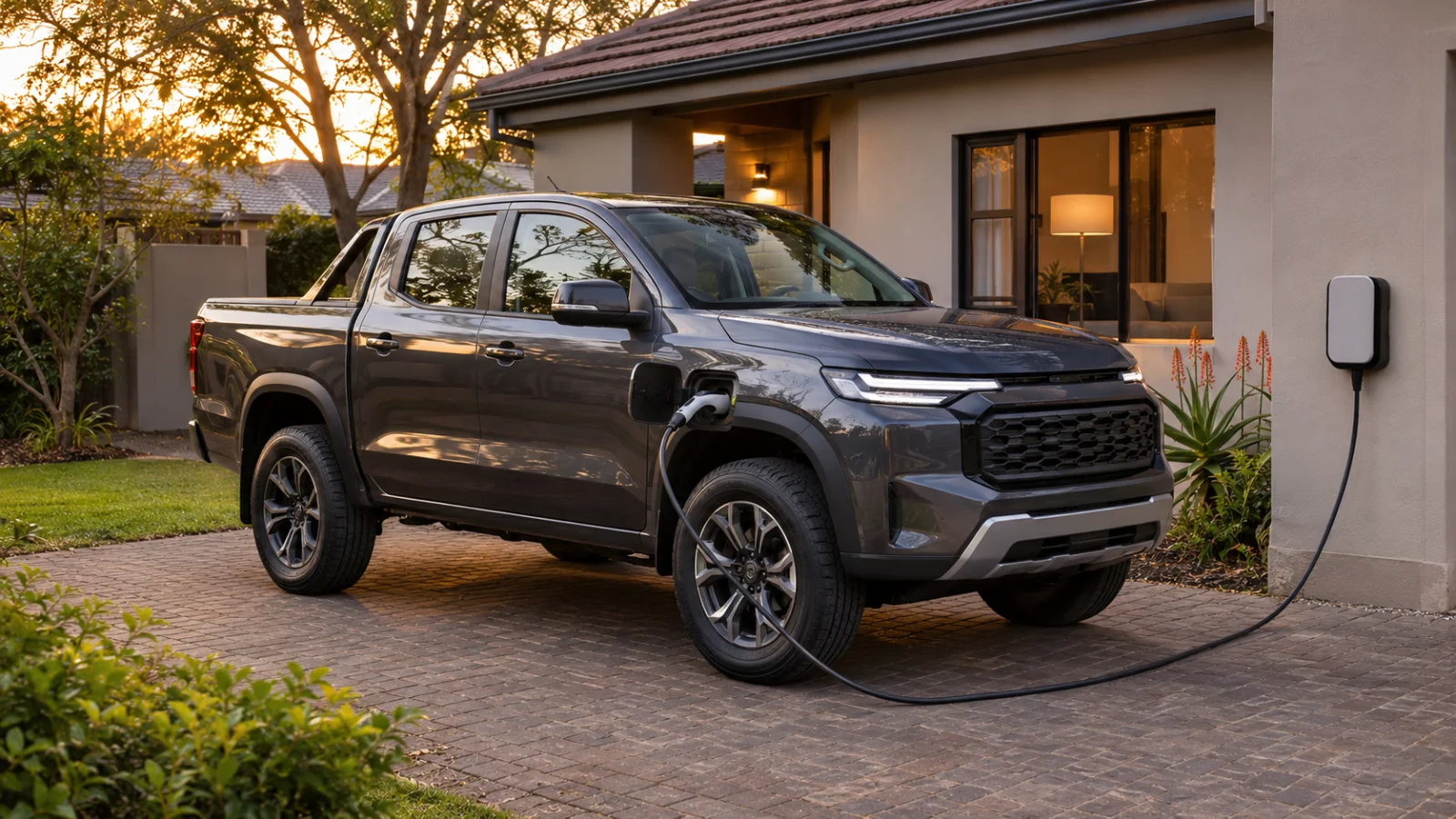
A diesel double cab costs about R262 per 100 km in fuel. A plug-in bakkie charged at home costs about R95. Over 25,000 km a year that gap is roughly R44,500. But a plug-in hybrid bakkie that never gets plugged in can cost more to run than the diesel it replaced.
Three electrified double cabs launched in South Africa between August and October 2026. Every review covers the specs. Almost none works out what they actually cost to run against a Hilux or a Ranger. Here is that calculation, with every assumption stated.
What is actually on sale
| Model | Type | Price | Battery | Claimed electric range | Towing |
|---|---|---|---|---|---|
| Riddara RD6 Econ Aspire RWD | Battery electric | R611,900 | 63 kWh | 369 km (NEDC) | Up to 3,000 kg |
| Riddara RD6 Econ Aspire AWD | Battery electric | R681,900 | 73 kWh | Up to 424 km (NEDC) | Up to 3,000 kg |
| Riddara RD6 Apex AWD | Battery electric | R781,900 | Not published | Not published | Up to 3,000 kg |
| Changan Hunter K50 REEV | Range extender | R799,900 | 31.2 kWh | 131 to 145 km | 2,000 to 2,200 kg |
| GWM P300 Hi4-T PHEV | Plug-in hybrid | R914,900 | 33.1 kWh | Up to 115 km (NEDC) | 3,500 kg |
| BYD Shark 6 Premium | Plug-in hybrid | R959,900 to R989,900 | 29.58 kWh | 80 to 100 km | 2,500 kg |
| BYD Shark 6 Performance | Plug-in hybrid | About R1.05m to R1.15m | 29.58 kWh | Up to 80 km | Not published |
Riddara figures from Cars.co.za and Stuff. GWM from Cars.co.za, also covered by TimesLIVE. Shark 6 from Cars.co.za and TechCentral. Changan from The Citizen and Changan South Africa.
Two things to know before you compare these numbers.
First, the electric range claims are not on the same test cycle. Most of these use NEDC, which is older and more generous than the WLTP standard used by European brands. Treat an NEDC figure as roughly 20 to 25 percent optimistic.
Second, published prices disagree. The Shark 6 Premium appears at R959,900, R969,900 and R989,900 across TechCentral, AutoTrader and its original launch coverage. The Performance is quoted at R1,049,900 by AutoTrader and around R1.15 million by TechCentral. Confirm with the dealer before you budget.
What each one costs to run
This is the part nobody publishes. Here is the method: energy consumption multiplied by the price of that energy, per 100 km.
Prices used. Inland 95 petrol at R30.24 a litre and wholesale 0.05 percent diesel at R30.86, per Central Energy Fund based forecasting data. Home electricity at R3.80 per kWh, which is a Johannesburg flat-rate figure and varies considerably by municipality.
| Scenario | Assumed consumption | Cost per 100 km |
|---|---|---|
| Diesel double cab | 8.5 litres per 100 km | About R262 |
| Battery electric bakkie, home charging | 22 kWh per 100 km | About R84 |
| Plug-in hybrid, running on electricity | 25 kWh per 100 km | About R95 |
| Plug-in hybrid, battery empty, on petrol | 9 to 10 litres per 100 km | About R272 to R302 |
The consumption figures are our working assumptions, not South African test results, because no local test data exists for these bakkies yet. Run your own numbers with our fuel fill up cost calculator and our EV charging cost calculator.
Over a year at 25,000 km: the diesel costs roughly R65,500 in fuel. The battery electric costs roughly R21,000 on home electricity. That is about R44,500 a year, which over five years is R222,500.
Now the warning. Look at the last row. A plug-in hybrid bakkie running on petrol costs more per kilometre than the diesel it replaced, because it is burning petrol at R30.24 rather than diesel at R30.86 while hauling an extra 300 kg of battery around. Buy one and never charge it, and you have paid a premium for worse running costs.
Which one for which job
Towing. The GWM P300 is the only electrified bakkie here rated at 3,500 kg, which matches what diesel Hilux and Ranger buyers expect. The Riddara manages 3,000 kg and the Shark 6 2,500 kg. Note that towing will cut a battery electric bakkie's range sharply, and we could not find any South African test that quantifies by how much.
Load. The Riddara RD6 and the Changan Hunter both claim around 1,000 kg of payload. The Shark 6 carries 835 kg, which is low for a double cab. GWM does not publish a payload figure for the P300.
Long distance. The plug-in hybrids and the range extender, without question. A battery electric Riddara rated 369 km on NEDC will realistically manage closer to 260 km at highway speed, which makes long trips a planning exercise. The petrol engine in the others removes that problem entirely.
Daily commuting. This is where the plug-ins earn their money. The GWM P300 at 115 km of claimed electric range and the Riddara both cover a typical commute without touching petrol. The Shark 6 does too, if you charge it every night.
How many are actually selling
Very few, and the context matters.
| Model | October 2026 sales |
|---|---|
| Toyota Hilux | 3,820 |
| Ford Ranger | 2,381 |
| Isuzu D-Max | 1,644 |
| GWM P-Series (all variants) | 666 |
| BYD Shark 6 | 113 |
Figures from Cars.co.za and CAR magazine, using naamsa data. The Shark 6 has run between 94 and 157 units a month since March 2026, per Cars.co.za.
So the Hilux outsells the Shark 6 by more than 30 to one. Electrified bakkies are not yet a volume story in South Africa. What they are is a curiosity story, and a cost question that a lot of diesel owners are quietly running in their heads. The Citizen reported diesel enquiries falling 18 percent over four weeks while battery electric searches rose 45 percent.
What about the Ford Ranger PHEV?
This is the one people ask about, because Ford builds it in Silverton, Pretoria.
It is not confirmed for South African sale. Imotonews reported in March 2026 that the local market had not been confirmed, and that remains the position. The Australian specification, per CarExpert, is an 11.8 kWh usable battery, a 2.3 EcoBoost with a 75 kW motor, 207 kW and 697 Nm combined, 49 km of claimed electric range and 3,500 kg of towing.
If you see a dealer listing a 2.3 Wildtrak as a plug-in hybrid, it is mislabelled. The South African 2.3T is a petrol model.
For reference, the ninth-generation Hilux launched in June 2026 with double cabs from R658,500 to R999,900, per CAR magazine. The Legend carries only a 48 volt mild hybrid system, not a plug-in.
The honest verdict
If you tow heavy and drive long distances, a diesel bakkie still makes the most sense, and the GWM P300 is the only electrified option that matches it on towing.
If your bakkie does a daily commute and weekend duty, and you have off-street parking and a charger, the maths changes completely. At R84 against R262 per 100 km, the running cost gap is large enough to offset a meaningful chunk of a higher purchase price.
If you cannot charge at home, do not buy a plug-in hybrid bakkie. You will pay the premium and get none of the benefit. That is the single most important sentence in this article.
Work out your own figures, with your own distance and tariff, using our EV versus petrol running cost calculator.
Frequently asked questions
What electric bakkies can you buy in South Africa?
The Riddara RD6 is the only fully electric double cab, from R611,900. The GWM P300 Hi4-T and BYD Shark 6 are plug-in hybrids, and the Changan Hunter K50 is a range extender. The Ford Ranger PHEV is built in Pretoria but is not confirmed for local sale.
How much does an electric bakkie cost to run in South Africa?
Roughly R84 per 100 km charging at home at R3.80 per kWh, against about R262 per 100 km for a diesel double cab at current prices. Over 25,000 km a year that is a difference of about R44,500.
Which electrified bakkie can tow 3,500 kg?
Only the GWM P300 Hi4-T PHEV, at R914,900. The Riddara RD6 is rated at 3,000 kg and the BYD Shark 6 at 2,500 kg.
Is a plug-in hybrid bakkie cheaper than a diesel?
Only if you charge it. Running on electricity it costs about R95 per 100 km. With an empty battery it uses roughly 9 to 10 litres per 100 km, which works out to R272 to R302, more than a diesel double cab.
How many electric bakkies are sold in South Africa?
Very few. The BYD Shark 6 sold 113 units in October 2026 against 3,820 Toyota Hilux. Monthly Shark 6 sales have ranged between 94 and 157 units since March 2026.