EV Charging in South Africa 2026: What Is Actually Built
By EV Cost Calculator Team · Published · Last updated
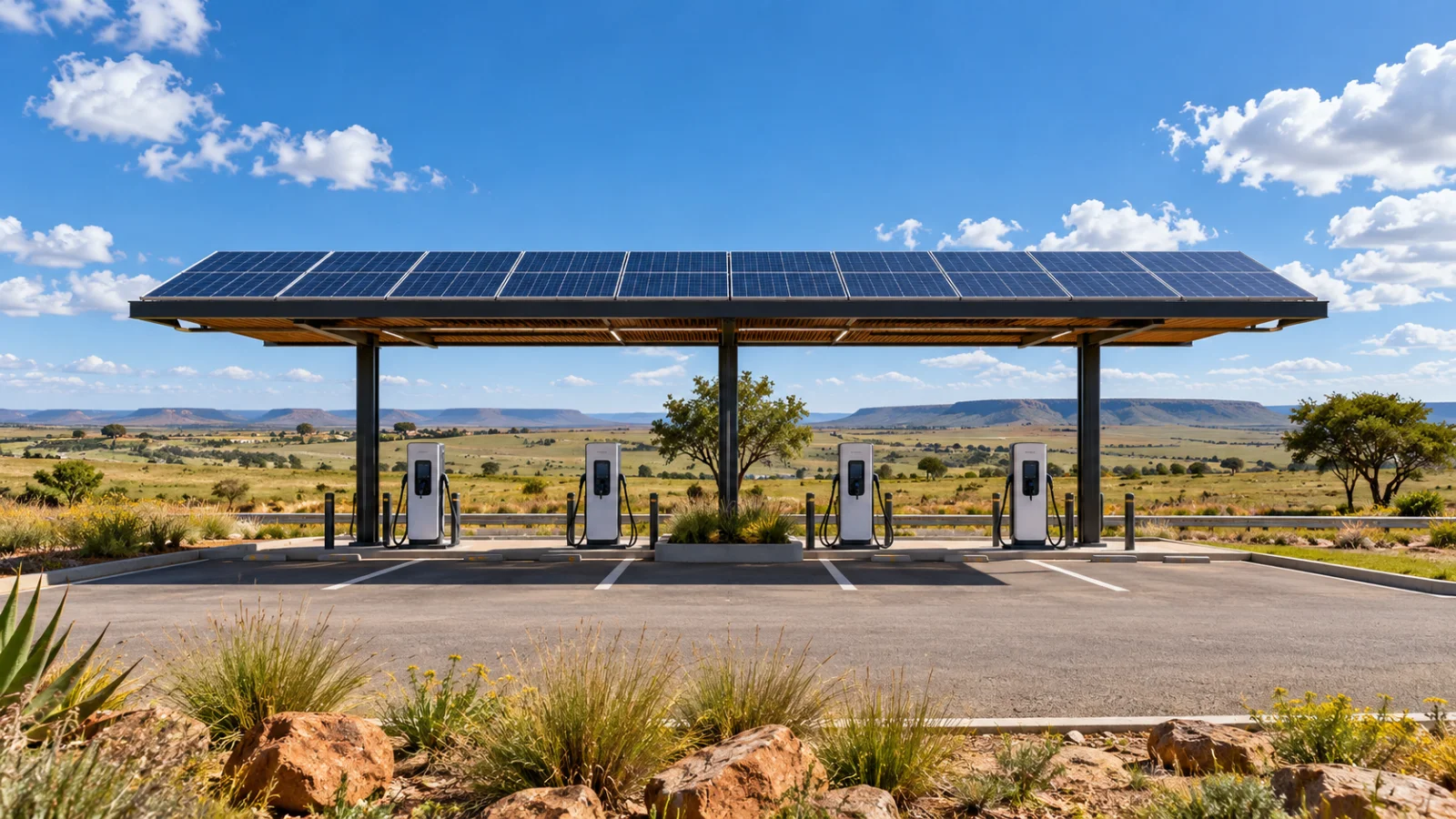
South Africa has somewhere above 600 public charging points. The honest answer is that nobody knows the exact number, because no official register exists. What is verifiable is that the network is growing, the economics of it are changing, and the prices went up in 2026.
Charging infrastructure is the most over-claimed topic in the local EV conversation. Numbers get repeated between sites without anyone checking the original source, and operator announcements get reported as if they are already built. This piece separates what is confirmed from what is still a promise.
How many charging points are there?
The most credible recent figure comes from Dr Andrew de Vries, director of the uYilo National Electric Mobility Programme at Nelson Mandela University, who put it at over 600 public charging points concentrated mainly in major cities, speaking to Engineering News in July 2026.
Other counts circulate, ranging from about 400 to about 650. They disagree largely because they count different things. A site, a charger and a connector are three different units, and a single site may hold several chargers, each with multiple connectors. Any growth rate calculated across these sources is unreliable.
What is not in dispute is the concentration problem. Coverage is heavily weighted towards Gauteng and the Western Cape, and thins out considerably on inland routes.
What charging costs
Public charging in South Africa is priced per kWh with no time of use variation. Rubicon set out the structure in detail: DC fast charging around R7.00 to R7.35 per kWh depending on which operator's app you use, and AC charging around R5.88 per kWh.
Those were 2025 benchmarks and prices have since risen. The Eastern Cape provincial network run by the AIDC-EC raised its wholesale tariff from R7.00 to R7.50 per kWh across 15 stations from 1 July 2026, according to the AIDC-EC.
Some sites charge considerably more. Premium and dealer branded locations have been reported at up to R11.76 per kWh.
For comparison, home charging on a typical metro tariff runs around R3.00 to R4.00 per kWh. Public DC fast charging therefore costs roughly double what charging in your own garage does, which is why the overwhelming majority of EV owners charge at home and use public charging for trips.
| Where you charge | Typical rate per kWh | Cost per 100 km at 15 kWh |
|---|---|---|
| Home, metro tariff | R3.00 to R4.00 | R45 to R60 |
| Public AC | Around R5.88 | About R88 |
| Public DC fast charging | R7.00 to R7.50 | R105 to R113 |
Work out what charging costs on your own tariff with our EV charging cost calculator.
The new players
The established operators are GridCars, which runs the largest share of public points and the ChargePocket app, and Rubicon, which operates public sites alongside dealership chargers. The more interesting development is who has entered since.
CHARGE, formerly Zero Carbon Charge, is building off-grid solar powered charging hubs on national routes rather than connecting to the Eskom grid. Its pilot site on the N12 at Wolmaransstad opened in November 2024. In May 2026 it opened a hub at the Reitz Interchange on the N3 in the Free State, backed by R100 million from the Development Bank of Southern Africa, alongside a second site at Tugela. The off-grid model matters because it removes both the grid connection cost and the load shedding exposure that have slowed other rollouts. uYilo expects off-grid sites to grow to nearly 100 within two years.
BYD has announced an ambitious flash charging rollout, with executive Stella Li stating in October 2025 that the company would have 200 to 300 flash charging stations in South Africa by the end of 2026, at power levels up to 1,000 kW. This is worth watching but should not be treated as built. Reporting through 2026 suggests the rollout has been delayed, and we could not verify any operational megawatt charging site in South Africa at the time of writing. Treat the 200 to 300 figure as a target, not a fact.
Dealer networks are quietly adding meaningful capacity. Autel Africa and Toyota have deployed over a hundred 22 kW chargers at dealerships.
Route coverage
The N3 between Gauteng and Durban is now the best served corridor, with the CHARGE hubs at Reitz and Tugela joining existing provision. The N12 has the Wolmaransstad site. The Eastern Cape has provincial network coverage on the N2 through AIDC-EC sites.
Coverage on the N1 and N4 is where we would want better data before making claims. If you are planning a long trip, check a live map rather than relying on any article, including this one.
What to know before you rely on public charging
CCS2 is the standard DC connector in South Africa, and Type 2 for AC. Most European and Chinese imports sold through official channels use these. Grey imports may use the Chinese GB/T standard, which is not compatible without an adapter and will not work on the local network.
Roaming agreements mean you can generally use one operator's app across another's chargers, though the app provider typically adds a margin of around 15 percent to the underlying rate. That is why the same physical charger can cost different amounts depending on which app you pay through.
Frequently asked questions
How many EV charging stations are there in South Africa?
There is no official register. The most credible recent estimate is over 600 public charging points, from the uYilo National Electric Mobility Programme in July 2026. Other counts range from about 400 to about 650 because they count sites, chargers and connectors differently.
How much does public EV charging cost in South Africa?
DC fast charging is roughly R7.00 to R7.50 per kWh and AC charging around R5.88 per kWh. Some premium sites charge considerably more. Home charging on a metro tariff is around R3.00 to R4.00 per kWh.
What plug do electric cars use in South Africa?
CCS2 for DC fast charging and Type 2 for AC charging. Grey imports using the Chinese GB/T standard are not compatible with the local public network without an adapter.
Is it cheaper to charge at home or at a public charger?
At home, by roughly half. Home charging costs about R45 to R60 per 100 km on a metro tariff, against about R105 to R113 per 100 km on public DC fast charging.
Can you drive an electric car between cities in South Africa?
On the main corridors, yes, with planning. The N3 is the best served route. Coverage is concentrated in Gauteng and the Western Cape and thins out on inland routes, so check a live charging map before a long trip.