Fuel Price Increases in South Africa: EV Savings Calculator
By EV Cost Calculator Team · Published · Last updated
Calculate Your Savings: Switching to an Electric Car in South Africa
Petrol prices above R25 per litre have South African drivers doing the maths on alternatives. The numbers often point in one direction: switching to an electric vehicle can cut your monthly running costs by more than half.
The actual savings depend on where you live, how you charge, and how far you drive. This guide breaks down the real costs, compares EVs to petrol vehicles kilometre by kilometre, and walks you through calculating what you'd actually save based on your situation.
How much can you save switching to an EV in South Africa
South African drivers who switch from petrol to electric vehicles typically save between R1,100 and R1,200 per month on running costs. The savings come down to a simple difference: EVs cost roughly R0.61 to R1.40 per kilometre to run, while petrol vehicles sit between R4.00 and R6.00 per kilometre. When you charge at home using residential electricity rates around R2.50 to R3.00 per kWh, the gap widens even further.
Three factors determine where your savings land within that range.
- Your province: Electricity tariffs differ across South Africa, so a driver in Gauteng pays a different rate than someone in the Western Cape
- How you charge: Home charging costs less than public DC fast charging, sometimes by half or more
- How far you drive: The per-kilometre savings compound with distance, so high-mileage drivers benefit most
A commuter covering 1,500 km monthly could realistically save R13,000 to R15,000 over a year. That said, your actual number depends on your specific situation, which is why running your own calculation matters more than relying on averages.
EV vs petrol cost per kilometre in South Africa
The cost-per-kilometre comparison is where the EV advantage becomes concrete. Take a typical petrol vehicle that uses 8 litres per 100 km. At R25 per litre, that works out to R2.00 for every kilometre driven. Now consider an EV using 15 kWh per 100 km, charged at home for R3.00 per kWh. The cost drops to roughly R0.45 per kilometre.
| Factor | Petrol vehicle | Electric vehicle |
|---|---|---|
| Energy unit cost | R25.00/litre | R2.50–R3.00/kWh (home) |
| Typical efficiency | 7–10 litres/100 km | 14–18 kWh/100 km |
| Cost per kilometre | R1.75–R2.50 | R0.40–R0.70 (home charging) |
What about public charging? Even at higher rates around R7.00 per kWh, the cost per kilometre lands near R1.00 to R1.40. The savings margin shrinks compared to home charging, but it doesn't disappear. You're still paying less than petrol.
What does it cost to charge an electric car in South Africa
Charging costs come down to two variables: your electricity tariff and your EV's battery size. The tariff is simply the price you pay per kilowatt-hour (kWh) of electricity. Battery capacity, measured in kWh, tells you how much energy your vehicle can store. Multiply the two, and you get your charging cost.
Electricity tariffs by province
Eskom and municipal tariffs vary depending on where you live. NERSA sets the regulatory framework, but your actual rate depends on your municipality and tariff structure. Most residential rates fall between R2.50 and R3.50 per kWh, though some areas charge more.
The most accurate way to know your tariff is to check your electricity bill. Look for the rate per kWh, and use that figure when estimating your charging costs. Provincial averages give you a starting point, but your bill tells the real story.
Charging from 20% to 80%
Most EV owners don't charge from empty to full every day. Instead, they charge between 20% and 80%, a practice that extends battery life and speeds up charging sessions. Batteries charge fastest in the middle range, so staying within this window keeps things efficient.
When you're calculating costs, using this 60% window reflects how people actually charge. A full 0% to 100% charge happens occasionally, but daily charging typically covers a smaller portion of the battery.
Full charge cost for popular EV models
A BYD Dolphin with a 44 kWh battery costs approximately R110 to R130 to charge fully at home rates. The Volvo EX30, with a larger 69 kWh battery, runs closer to R170 to R210. Bigger SUVs like the BMW iX3, carrying an 80 kWh battery, cost around R200 to R240 for a complete charge.
- Smaller battery EVs (40–50 kWh): R100–R150 per full charge, delivering 300–400 km of range
- Larger battery EVs (70–80 kWh): R175–R250 per full charge, delivering 400–500 km of range
The relationship is straightforward: bigger batteries cost more to fill but take you further between charges.
Home charging vs public charging costs
Where you plug in affects what you pay. Home and public charging serve different purposes and come with different price tags.
Charging at home with Eskom tariffs
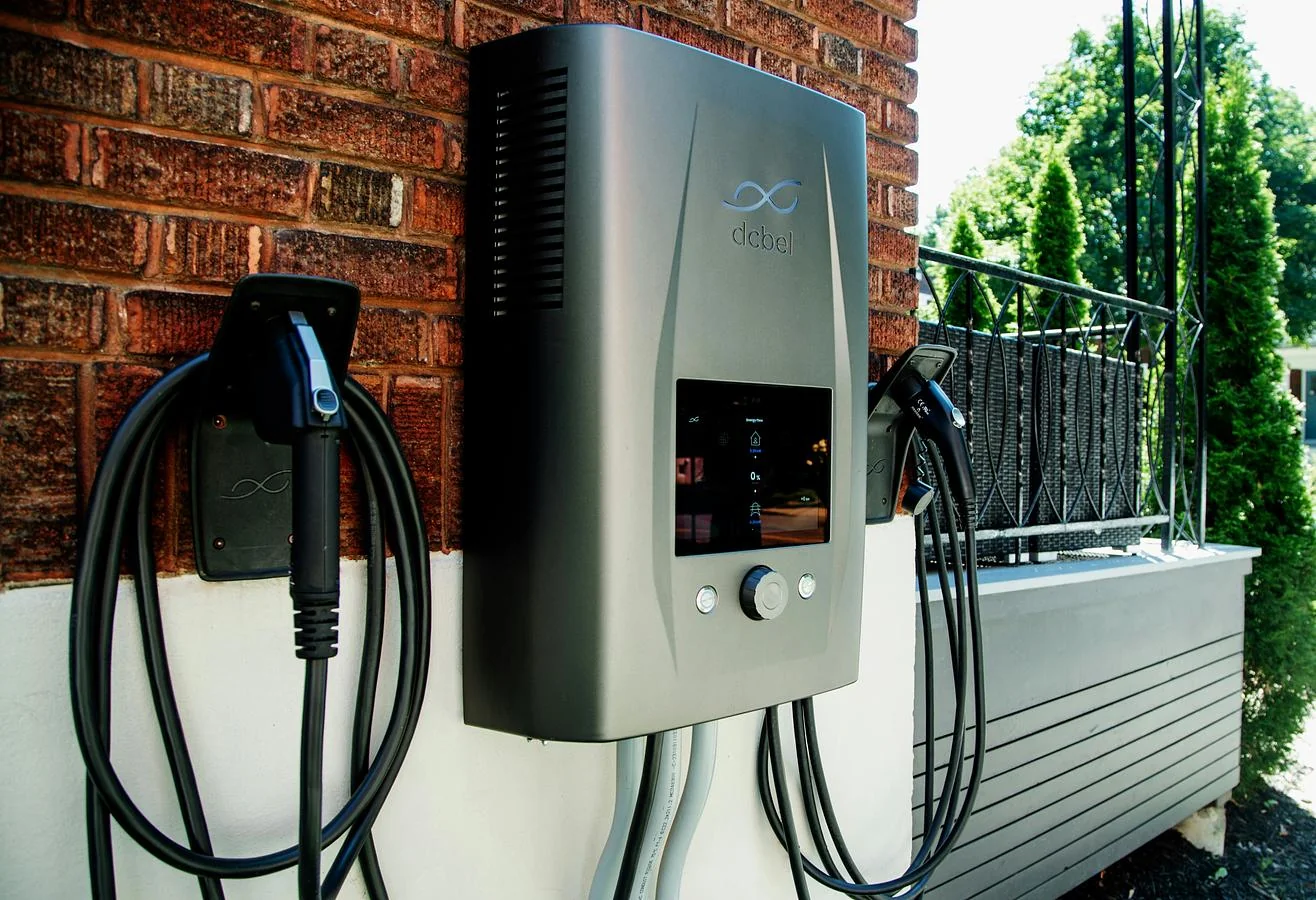
Home charging uses your household electricity rate, which makes it the cheapest option for most drivers. At R2.75 per kWh, you can charge overnight while you sleep and wake up to a full battery. Some municipalities offer time-of-use tariffs, where off-peak hours cost less. Charging between 10pm and 6am, for example, could reduce your costs further.
The convenience factor matters too. You plug in when you get home, and the car handles the rest. No detours, no waiting, no apps to manage.
Public DC charger networks and pricing
South Africa's public charging networks include GridCars, Audi Charge, BMW ChargeNow, and Mercedes me Charge. DC fast chargers at these stations typically cost R6.00 to R8.00 per kWh, roughly double or triple what you'd pay at home.
The trade-off is speed. A DC charger can add 100 km of range in 15 to 20 minutes, which makes long trips practical. You pay more per kilometre, but you're not waiting hours to get back on the road.
When public charging makes sense
Public charging works well in specific situations: long-distance trips where home charging isn't an option, quick top-ups during shopping or errands, or for drivers who don't have access to home charging at all. The higher cost per kWh is the price of convenience and speed.
For daily driving, home charging delivers the best value. For flexibility and road trips, public chargers fill the gap.
How to calculate your monthly EV savings
Working out your personal savings takes three steps. You can do this with a calculator and your electricity bill, or use an online tool that pulls in current South African data automatically.
1. Enter your current fuel spend
Start with what you're spending now. Take your typical tank cost and multiply it by how many times you fill up each month. Then estimate your total kilometres driven over that period.
For example, a driver spending R1,200 per tank, filling up four times monthly, and covering 2,000 km has a baseline of R4,800 in monthly fuel costs. That's the number you're comparing against.
2. Select your province and EV model
Your province determines your electricity tariff, and your chosen EV determines efficiency. A more efficient vehicle in a lower-tariff province saves more than a less efficient model in a higher-tariff area.
Picking a specific EV you're actually considering makes the comparison meaningful. Generic estimates only get you so far.
3. Compare your results
The output shows your estimated monthly EV charging cost alongside your current petrol spend. The difference between the two is your potential savings. EV Cost Calculator's Fuel vs EV Comparison tool runs this calculation using current South African fuel prices and provincial electricity tariffs, so the numbers reflect what you'd actually pay.
EV maintenance costs vs petrol vehicle servicing
Beyond fuel, EVs cost less to maintain over time. The reason is mechanical: electric motors have fewer moving parts than internal combustion engines, which means fewer components that wear out or break.
- No oil or filter changes: Electric motors don't use engine oil, eliminating one of the most common service items
- Reduced brake wear: Regenerative braking uses the motor to slow the car, which extends brake pad life significantly
- Battery health: Most manufacturers offer 8-year battery warranties, and degradation happens gradually over many years
- Tyres and suspension: These wear at similar rates to petrol vehicles and require the same maintenance
Over five years of ownership, the maintenance savings add up. You're not paying for oil changes, spark plugs, timing belts, or exhaust repairs.
Which electric cars offer the best savings in South Africa
Running cost efficiency varies by model. Smaller, lighter EVs typically cost less per kilometre than larger ones, though the relationship isn't always linear.
Entry-level EVs under R700 000
The BYD Dolphin and similar compact EVs achieve efficiency ratings around 14–16 kWh per 100 km. Lower purchase prices combined with low running costs make these models attractive for drivers focused on value.
Mid-range EVs for families
SUVs like the Volvo EX30 and Mercedes-Benz EQA balance interior space with reasonable efficiency. Expect 16–19 kWh per 100 km, which still delivers substantial savings compared to petrol equivalents in the same segment.
Premium EVs with lowest running costs
Some premium models achieve excellent efficiency despite their size. The BMW iX3, for instance, manages around 18 kWh per 100 km. Higher purchase prices mean longer payback periods, but the running costs remain competitive with smaller vehicles.
Challenges that can affect your EV savings
Switching to an EV involves trade-offs. Understanding the limitations helps set realistic expectations.
Higher upfront purchase price
EVs typically cost more than equivalent petrol vehicles. Entry-level options like the BYD Dolphin start under R600,000, but comparable petrol hatchbacks cost less. Running cost savings offset this premium over time, though the break-even point varies depending on how much you drive.
Charging infrastructure availability
Public charger coverage is expanding but remains uneven across South Africa. Urban areas have more options than rural regions, and some routes have gaps between stations. The EV Charging Station Map shows stations across major networks, which helps when planning trips or assessing coverage in your area.
Electricity price increases
Eskom tariffs rise annually, and those increases affect charging costs. However, petrol prices also fluctuate, often more dramatically. The per-kilometre cost advantage for EVs typically holds even as electricity prices climb.
Who will save the most by switching to an EV
Some drivers benefit more than others from making the switch. Your driving patterns and charging access determine how much of the potential savings you'll actually capture.
Daily commuters with predictable routes
If you drive similar distances each day, you can charge overnight and rarely think about range. Predictable patterns make home charging straightforward, and you start each morning with a full battery.
Drivers with home charging access
Access to a home charger, even a standard wall socket, unlocks the lowest charging costs. Without home charging, you'll rely on public infrastructure and pay more per kilometre. The savings are still there, but the margin narrows.
High-mileage drivers
The more kilometres you cover, the more the per-kilometre savings compound. A driver covering 25,000 km annually saves far more in absolute terms than someone driving 10,000 km, even though the rate per kilometre is the same.
Start calculating your EV savings today
Your savings depend on your driving patterns, your location, and the EV you're considering. Averages give you a sense of what's possible, but your specific numbers tell the real story. Calculate your personal savings using EV Cost Calculator, which uses current South African fuel prices and your provincial electricity tariff to show what switching could actually save you.
FAQs about EV savings in South Africa
What is the 80% rule for EV charging?
The 80% rule refers to charging your battery to 80% rather than 100% for daily use. Staying below 80% preserves battery health over time and reduces charging duration at DC fast chargers, where the charging rate slows significantly above that threshold.
How long does it take to break even on an EV purchase in South Africa?
Break-even time depends on your annual mileage, electricity costs, and the price difference between your EV and a comparable petrol vehicle. High-mileage drivers often recover the premium within three to five years through accumulated fuel savings.
Do EV running cost savings increase with solar panels?
Yes. Charging with solar power reduces or eliminates your electricity cost per kilometre, pushing savings beyond what grid charging offers. The upfront cost of solar installation factors into the overall calculation.
Can drivers without home charging still save money with an EV?
Drivers who rely on public charging can still save compared to petrol, though the margin is smaller. Public DC chargers cost more per kWh than home electricity, but the per-kilometre cost typically remains below petrol prices.
How do EV insurance costs compare to petrol vehicle insurance in South Africa?
EV insurance premiums may be higher due to purchase price and specialised repair costs, though rates vary by insurer and model. Comparing quotes from multiple insurers helps factor insurance into your total ownership calculation.