Johannesburg to Durban in an Electric Car: The Easiest Long Drive in SA
By EV Cost Calculator Team · Published · Last updated
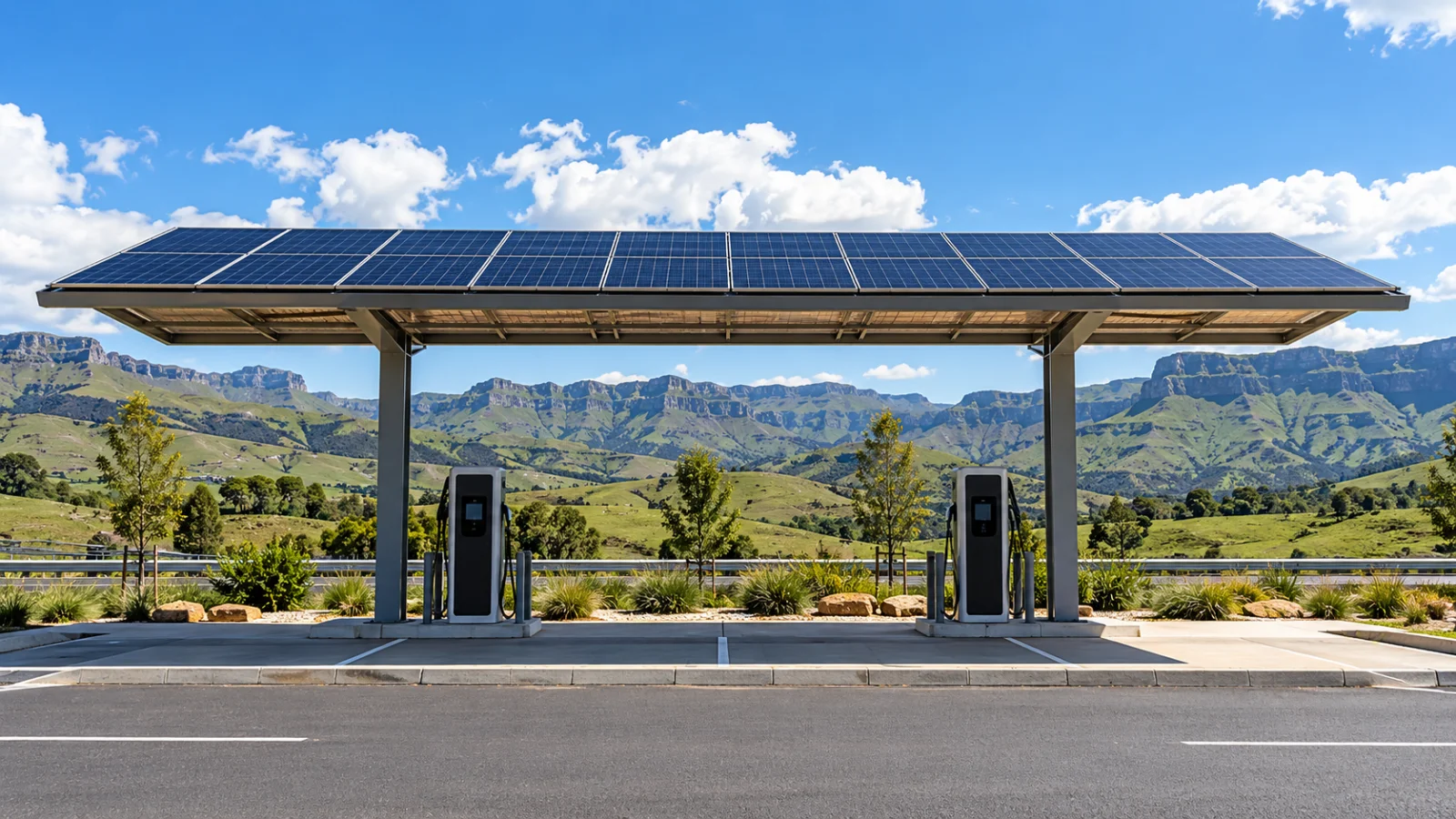
Johannesburg to Durban is the easiest long EV drive in South Africa. The N3 has a working DC charger roughly every 80 km, including two new off-grid solar hubs that opened in May 2026, and most modern electric cars need only one or two stops.
If you are nervous about a first long EV trip, this is the route to do it on. Here is what is actually on the road, with a source for every site.
The route and the distances
MyBroadband measured 592 km from Centurion to Durban on a Volvo EX30 trip, with these legs:
| Leg | Distance |
|---|---|
| Centurion to Sasol Thanda Tau | 213 km |
| Thanda Tau to near Harrismith | 113 km |
| Harrismith to Engen Tugela | 42 km |
| Tugela to Mooi River | 97 km |
| Mooi River to Durban | 127 km |
That same report counted seven DC sites between Johannesburg and Durban, working out to a charger roughly every 81 km. It is the densest intercity charging corridor in the country.
Verified DC charging sites on the N3
| Location | Site | Operator | DC power |
|---|---|---|---|
| Free State, N3 south | Sasol Thanda Tau | Rubicon | 100 kW |
| Reitz Interchange, Exit 107 | CHARGE N3 Roadside | CHARGE | 3 chargers, 6 dispensers |
| Harrismith | Engen 1 Stop Bergview | GridCars | 50 kW, plus 22 kW AC |
| Colenso and Winterton, Exit 207 | CHARGE N3 Tugela | CHARGE | 3 chargers, 6 dispensers |
| Tugela, N3 south | Engen Tugela | GridCars | 80 kW and 150 kW, plus 22 kW AC |
| Mooi River | Engen Mooi 1 Stop | GridCars | 30 kW |
Sources: Thanda Tau and Engen Tugela from MyBroadband, Harrismith from Chargemap, Mooi River from PlugShare, and the CHARGE hubs from Engineering News.
The Harrismith site has history. It was the first GridCars highway DC charger in the country, installed in May 2018.
The new solar hubs
The most significant change on this route is CHARGE opening two off-grid solar charging hubs in May 2026, at the Reitz Interchange and at Tugela. Engineering News reported the launch and The Mercury covered it from the KwaZulu-Natal side.
What makes them different:
- They are off-grid. Solar microgrids with battery storage, backed by a biodiesel generator. No Eskom connection, so no load shedding exposure.
- Capacity. Each hub has three DC chargers feeding six dispensers plus two AC points, serving up to eight vehicles at once, with 360 kW of combined DC capacity.
- Funding. Backed by a R100 million investment from the Development Bank of Southern Africa.
- Speed. CHARGE says most EVs go from 10 to 80 percent in about 25 minutes.
On pricing, the CHARGE hub page lists DC at R9.15 per kWh including VAT, and AC charging free until the end of May 2027. The DC rate is the most expensive on the route, so weigh that against the convenience and the reliability of an off-grid site.
They are being used. CHARGE reported 117 charging sessions and 4,213.4 kWh delivered across the two hubs over the Heritage Day weekend in September 2026.
Planning your stops
Assuming a full battery at departure and arriving with at least 15 percent.
Around 300 km of real range. Stop at Reitz or Thanda Tau, then at Tugela, then run into Durban. Tugela to Durban is about 224 km, so if you arrive at Tugela low, add Mooi River as a short top-up. Three stops, all with alternatives nearby.
Around 400 km of real range. One stop at Tugela in principle, which is about 368 km from Centurion. That is tight enough that a brief top-up at Reitz or Thanda Tau is the sensible call rather than arriving on fumes.
Around 500 km of real range. One comfortable stop, at Reitz, Harrismith or Tugela. Pick based on where you want to eat.
Van Reenen's Pass
The N3 climbs from the KwaZulu-Natal lowlands to the Free State plateau over Van Reenen's Pass, and this affects range asymmetrically.
Heading north to Johannesburg, the climb increases consumption noticeably, so leave Tugela with more buffer than the distance alone suggests. Heading south to Durban, the descent returns energy through regenerative braking, and many drivers arrive at the bottom with more range showing than they expected.
We could not source reliable elevation or consumption figures for the pass, so we are not publishing numbers. Treat it as a reason for a northbound buffer rather than a calculation.
What the trip costs
Using 18 kWh per 100 km for highway driving, the 600 km trip needs roughly 108 kWh.
| How you charge | Trip cost |
|---|---|
| Public DC at R7.35 per kWh | About R794 |
| Public DC at R9.15 per kWh, the CHARGE rate | About R988 |
| Petrol at 7 litres per 100 km and R30.25 | About R1,271 |
Our calculations on the stated assumptions. Tariff benchmarks from Rubicon. Starting from a full home charge cuts the public charging cost substantially, because the first and often largest charge costs you home rates rather than DC rates. Check yours with our EV charging cost calculator.
Practical advice
- Register for GridCars, Rubicon and CHARGE separately. GridCars and Rubicon accounts work across each other's chargers. It is not confirmed whether CHARGE accepts either, so set up a CHARGE account before you go.
- The AC chargers at the CHARGE hubs are free until May 2027. If you are stopping for a long meal anyway, that is worth knowing.
- Tugela has the most redundancy on the route. Engen Tugela and the CHARGE hub are close together, which makes it the safest place to plan a charge.
- Mooi River is only 30 kW. Useful as a top-up, slow as a main stop.
Where this data comes from
Charging locations come from the MyBroadband Volvo EX30 road trip report, operator announcements by CHARGE covered in Engineering News and The Mercury, the CHARGE hub page, and public charger directory listings at Chargemap and PlugShare. A second recent account of the route, the Mail and Guardian's iCAUR 03T road trip, provides corroboration on the practical experience.
Two limitations. South Africa has no official register of public charging points, so no route guide can claim completeness. And the MyBroadband site survey dates from 2024, so the network has almost certainly grown since. Verify against a live charging app before departure.
Frequently asked questions
Can you drive an electric car from Johannesburg to Durban?
Yes, comfortably. The N3 has a verified DC charger roughly every 80 km, and most modern electric cars need only one or two stops for the 592 km trip.
How many charging stops does Johannesburg to Durban need?
One stop in a car with around 500 km of real-world range, one or two with around 400 km, and two or three with around 300 km.
Where are the solar charging stations on the N3?
CHARGE operates two off-grid solar hubs, at the Reitz Interchange, Exit 107, and at Tugela, Exit 207. Both opened in May 2026, run three DC chargers feeding six dispensers, and can serve eight vehicles at once.
How much does it cost to drive an EV from Johannesburg to Durban?
Roughly R794 to R988 in public DC charging for the 592 km trip, against about R1,271 in petrol for a car using 7 litres per 100 km.
Does Van Reenen's Pass affect electric car range?
Yes, asymmetrically. The northbound climb towards Johannesburg increases consumption, so leave Tugela with extra buffer. The southbound descent towards Durban returns energy through regenerative braking.