Petrol Hits R30.25 Tonight: The October 2026 Fuel Price Explained
By EV Cost Calculator Team · Published · Last updated
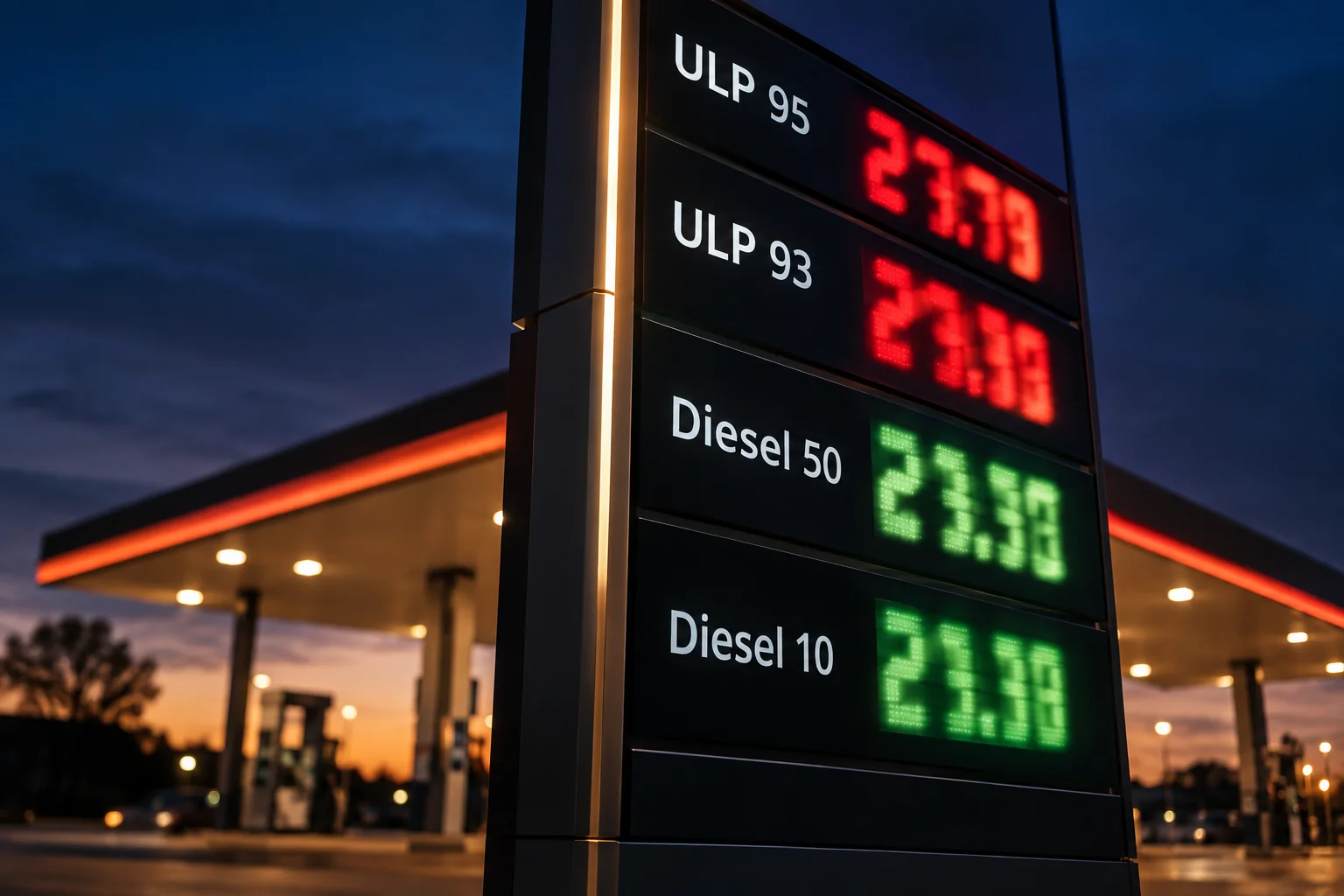
From midnight tonight, inland 95 unleaded costs R30.25 a litre. That is R3.33 more than yesterday, the biggest single monthly increase on record for the grade, and the first time petrol has crossed R30 in South Africa.
The Department of Mineral and Petroleum Resources confirmed the adjustment on Monday 5 October. It takes effect at 00:01 on Wednesday 7 October. Here is exactly what changes, why it happened, and what it does to the cost of running a car.
What you will pay from Wednesday
The department's own statement publishes the increases rather than the pump prices. The actual zone by zone prices come from the Magisterial District Zone schedule released on 6 October. These are the confirmed increases:
| Fuel | Increase |
|---|---|
| Petrol 93 (ULP and LRP) | 312.0 c/l |
| Petrol 95 (ULP and LRP) | 333.0 c/l |
| Diesel 0.05% sulphur (500ppm) | 284.38 c/l |
| Diesel 0.005% sulphur (50ppm) | 324.38 c/l |
| Illuminating paraffin (wholesale) | 358.0 c/l |
| LPGas | 42 c/kg, or 48 c/kg in the Western Cape |
Source: Department of Mineral and Petroleum Resources media statement, 5 October 2026
Translated into pump prices:
| Fuel | September | From 7 October |
|---|---|---|
| 95 unleaded, inland | R26.92 | R30.25 |
| 93 unleaded, inland | R26.76 | R29.88 |
| 95 unleaded, coastal | R26.05 | R29.38 |
| Diesel 500ppm, inland (wholesale) | R29.11 | R31.95 |
| Diesel 500ppm, coastal (wholesale) | R28.24 | R31.08 |
Sources: BusinessTech and Getaway
One figure to treat with care. The new inland price for 50ppm diesel is reported as R33.29 by BusinessTech, while the Central Energy Fund statement puts it at R32.80. The increase of 324.38 c/l is not in dispute, but the base differs between sources. Diesel prices are also wholesale rather than regulated retail, so what you actually pay at the pump will be higher. IOL expects forecourt diesel to land between R33 and R35.
Note too that 93 and 95 moved by different amounts. That is not an error. The octane differential in the basic fuel price is reset on the first Wednesday of each quarter, and October opens the fourth quarter.
Why it happened
Almost all of this is imported cost, not tax. The department gives three reasons.
Crude oil. Brent averaged 101 US dollars a barrel over the review period, up from 87.89. The department attributes the rise to continued US and Iran tensions, uncertainty over the flow of oil through the Strait of Hormuz, higher shipping costs and falling inventories.
Product prices. International prices for refined petrol, diesel and paraffin rose on supply shortages. This added 329.07 c/l to the basic fuel price of petrol, 280.17 c/l to diesel and 357.23 c/l to paraffin. That single line accounts for essentially the entire increase.
The rand did nothing. The currency averaged R16.212 to the dollar against R16.213 in the previous period. That fractional appreciation pulled just 0.17 c/l off the petrol basic fuel price. For once the exchange rate is not the story.
On top of that, the slate levy rose from 83.28 c/l to 87.66 c/l, an increase of 4.38 c/l, to work off a negative slate balance of R10.45 billion at the end of August. The General Fuel Levy and the Road Accident Fund levy did not change this month.
What it costs you
A 50 litre tank of inland 95 now costs R1,512.50, up R166.50 from September. A 60 litre tank costs R1,815.00, up R199.80.
Over a year at 15,000 km in a car using 7 litres per 100 km, you will spend about R31,763 on fuel at the new price, against R28,266 at the September price. That is roughly R3,500 a year from one adjustment.
You can work out your own figure, for your tank size and your car, with our fuel fill up cost calculator.
The year so far
Inland 95 opened 2026 at R20.75 in January. At R30.25 it is now R9.50 higher, an increase of 45.8 percent in ten months. There have been six increases and four decreases across the year, with the previous record of R28.06 set in June. Price history is published by the Fuels Industry Association of South Africa.
What this does to the electric car argument
Every fuel increase shifts the running cost comparison, and this one shifts it sharply.
Take a small electric hatchback using about 15 kWh per 100 km in real conditions. Charged at home on a typical metro tariff of around R3.30 per kWh, that is R49.50 per 100 km. On a public DC fast charger at R7.50 per kWh it is R112.50 per 100 km.
A petrol car using 6 litres per 100 km now costs R181.50 per 100 km. A car using 7 litres costs R211.75.
| How you fuel it | Cost per 100 km |
|---|---|
| Electric, charged at home | About R50 |
| Electric, public DC fast charging | About R113 |
| Petrol at 6.0 L/100 km | R181.50 |
| Petrol at 7.0 L/100 km | R211.75 |
These are our calculations using the new October price and the stated consumption assumptions. Home electricity tariffs vary considerably by municipality, so run your own numbers with our EV charging cost calculator and our EV versus petrol running cost calculator.
The honest caveat is that this compares fuel cost only. It does not account for the purchase price difference, insurance or depreciation. But on fuel alone, charging at home is now roughly a quarter of the cost of filling up.
Frequently asked questions
How much is petrol in South Africa from 7 October 2026?
Inland 95 unleaded costs R30.25 a litre and inland 93 costs R29.88. At the coast, 95 costs R29.38.
How much did petrol go up in October 2026?
Petrol 95 rose by R3.33 a litre and petrol 93 by R3.12. Diesel rose by R2.84 a litre for 500ppm and R3.24 for 50ppm, both wholesale.
Why did the petrol price increase so much?
Almost entirely because of international product prices, which added 329.07 c/l to the basic fuel price of petrol after Brent crude rose from 87.89 to 101 US dollars a barrel. The rand was effectively flat and the fuel levies did not change.
What does it cost to fill a tank now?
A 50 litre tank of inland 95 costs R1,512.50, which is R166.50 more than in September. A 60 litre tank costs R1,815.00.
When is the next fuel price change?
Fuel prices are adjusted on the first Wednesday of each month, so the next adjustment is due on 4 November 2026.