South Africa's Cheapest EV Now Costs R339,900
By EV Cost Calculator Team · Published · Last updated
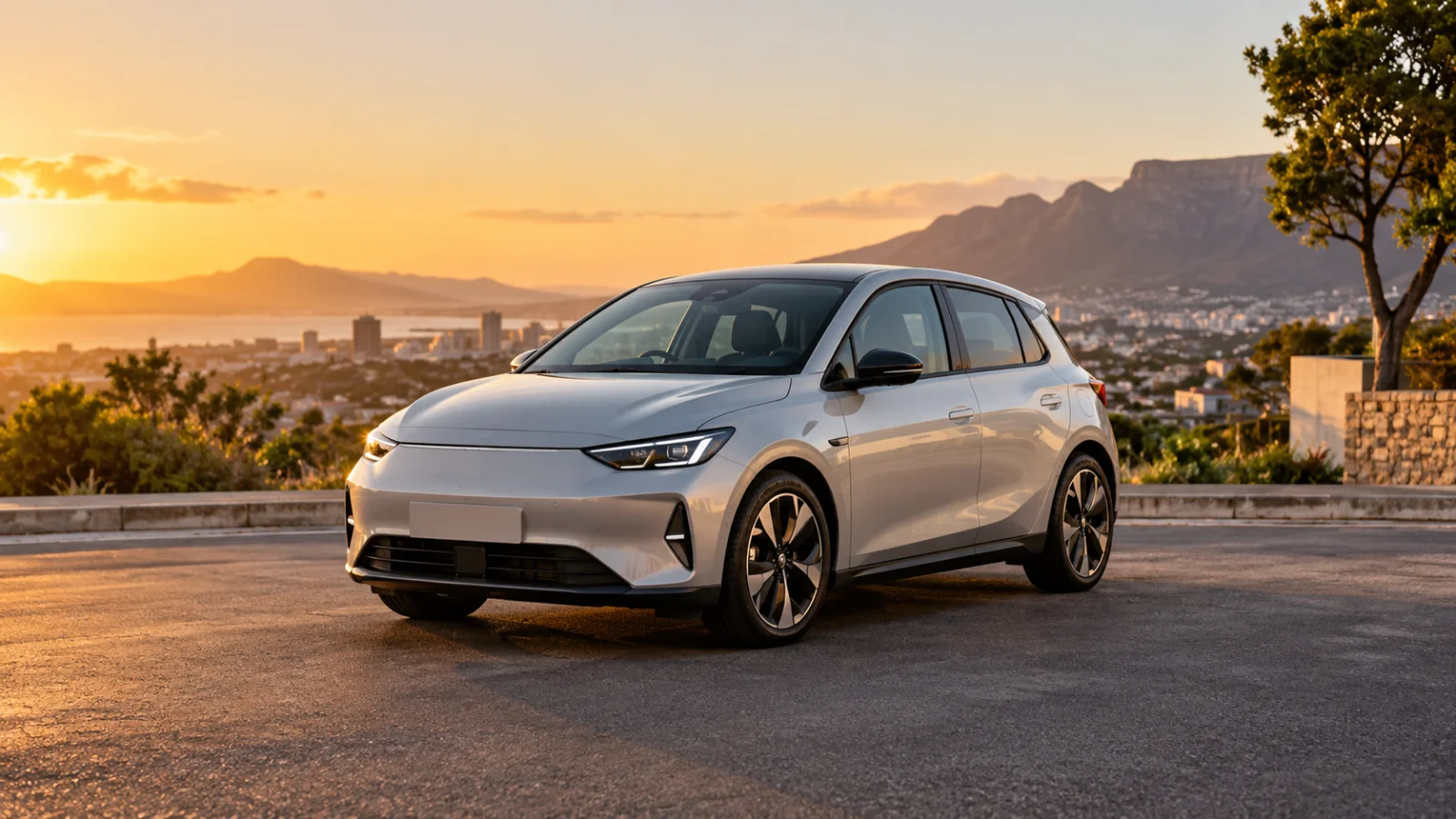
The cheapest new electric car in South Africa now costs R339,900. Three years ago the cheapest was close to R800,000. That is a fall of roughly 57 percent, and it is the single biggest change in the local EV market.
Four electric cars are now priced under R350,000. For context, that is the same money as a mid specification petrol hatchback. The price barrier that kept EVs as a luxury purchase in South Africa has largely come down, and it happened fast.
The four cheapest electric cars in South Africa
| Model | Price from |
|---|---|
| Geely E2 Aspire | R339,900 |
| BYD Dolphin Surf Comfort | R341,900 |
| Dongfeng Box E2 430 | R349,000 |
| Chery Q Comfort | R349,900 |
Source: Cars.co.za, 5 most affordable EVs in South Africa (2026)
The Geely E2 launched locally in April 2026 and took the cheapest EV title from the BYD Dolphin Surf by R2,000, as Cars.co.za reported at the time. TopAuto noted that the Dolphin Surf had held that title since September 2025.
Worth flagging: some aggregator sites list the Dolphin Surf at R339,900. The manufacturer price confirmed by Cars.co.za, TopAuto, IOL and AutoTrader is R341,900 for the Comfort.
How the two cheapest compare
| Spec | Geely E2 Aspire | BYD Dolphin Surf Comfort |
|---|---|---|
| Price from | R339,900 | R341,900 |
| Battery | 39.4 kWh | 30 kWh |
| Claimed range | 325 km WLTP | 232 km |
| Power | 85 kW | 55 kW |
Source: AutoTrader. The Dolphin Surf Dynamic, at R393,900, steps up to a 38.8 kWh battery and 295 km of claimed range.
How quickly the floor dropped
Cars.co.za notes that in 2023 the most affordable EV on the local market was priced at nearly R800,000. The sequence since then has moved quickly: the GWM Ora 03 undercut that, the Dayun S5 undercut the Ora, the BYD Dolphin Surf took the title in September 2025, and the Geely E2 took it in April 2026.
Every one of the four cheapest EVs on sale today is from a Chinese manufacturer. That is the mechanism behind the price fall.
Buyers are responding
New energy vehicle sales data from naamsa, the Automotive Business Council, shows the shift clearly. In the first eight months of 2026, 18,945 new energy vehicles were sold, already 13.4 percent more than the 16,703 sold in the whole of 2025, with four months of the year still to run.
| Type | Share of NEV sales, year to date |
|---|---|
| Traditional hybrid | 49.6% |
| Plug-in hybrid | 36.5% |
| Battery electric | 13.8% |
Source: naamsa September 2026 new vehicle sales release
Roughly one in every twenty new vehicles sold in South Africa this year is electrified. Battery electric sales reached 2,622 units by the end of August, and plug-in hybrids 6,919, both already past their full year 2025 totals as Business Day reported. Rechargeable vehicles, meaning plug-in hybrids and battery electrics together, now account for just over half of all new energy vehicle sales, which is a real change in a market that was historically almost entirely conventional hybrids.
What they cost to run
This is where the case gets strong, particularly after the October fuel increase took inland 95 to R30.25 a litre.
Using about 15 kWh per 100 km in real conditions for a small electric hatch:
| How you fuel it | Cost per 100 km | Cost over 15,000 km |
|---|---|---|
| Electric, home charging at R3.30/kWh | About R50 | About R7,425 |
| Electric, public DC at R7.50/kWh | About R113 | About R16,875 |
| Petrol at 6.0 L/100 km | R181.50 | R27,225 |
These are our calculations using the October 2026 petrol price and the stated assumptions. Home tariffs vary by municipality, so check yours with our EV charging cost calculator.
On those figures, charging at home saves close to R20,000 a year against petrol at 15,000 km. Run your own distance and tariff through our EV versus petrol running cost calculator.
What has not changed
Three things keep the picture honest.
There is still no consumer incentive. South Africa offers no purchase rebate or subsidy for buying an electric car. The Section 12V allowance that took effect on 1 March 2026 is a 150 percent tax deduction for manufacturers who produce electric or hydrogen vehicles locally, not a consumer benefit. Werksmans Attorneys has a clear summary of what it covers.
Import duties still penalise EVs. Imported electric vehicles attract a higher import duty than combustion vehicles, which is a large part of why prices remain above comparable markets.
Budget petrol cars are still cheaper to buy. At R339,900 the cheapest EV competes with mid specification hatchbacks, not with entry level cars under R250,000. The running cost saving is real, but it is paying down a purchase premium rather than being free money.
Frequently asked questions
What is the cheapest electric car in South Africa?
The Geely E2 Aspire at R339,900, which launched in April 2026 and undercut the BYD Dolphin Surf by R2,000.
How many electric cars cost under R350,000 in South Africa?
Four. The Geely E2 Aspire at R339,900, BYD Dolphin Surf Comfort at R341,900, Dongfeng Box E2 430 at R349,000 and Chery Q Comfort at R349,900.
How much have EV prices fallen in South Africa?
The cheapest EV cost close to R800,000 in 2023 and now costs R339,900, a fall of roughly 57 percent in about three years.
Are there government incentives for buying an EV in South Africa?
No. There is no consumer purchase rebate or subsidy. The Section 12V tax allowance that began on 1 March 2026 applies to manufacturers producing electric vehicles locally, not to buyers.
How many electric cars are sold in South Africa?
Battery electric vehicle sales reached 2,622 units in the first eight months of 2026, which is 13.8 percent of new energy vehicle sales. Total new energy vehicle sales were 18,945 over that period.