What a Tank of Petrol Cost in 2006, 2016 and 2026
By EV Cost Calculator Team · Published · Last updated
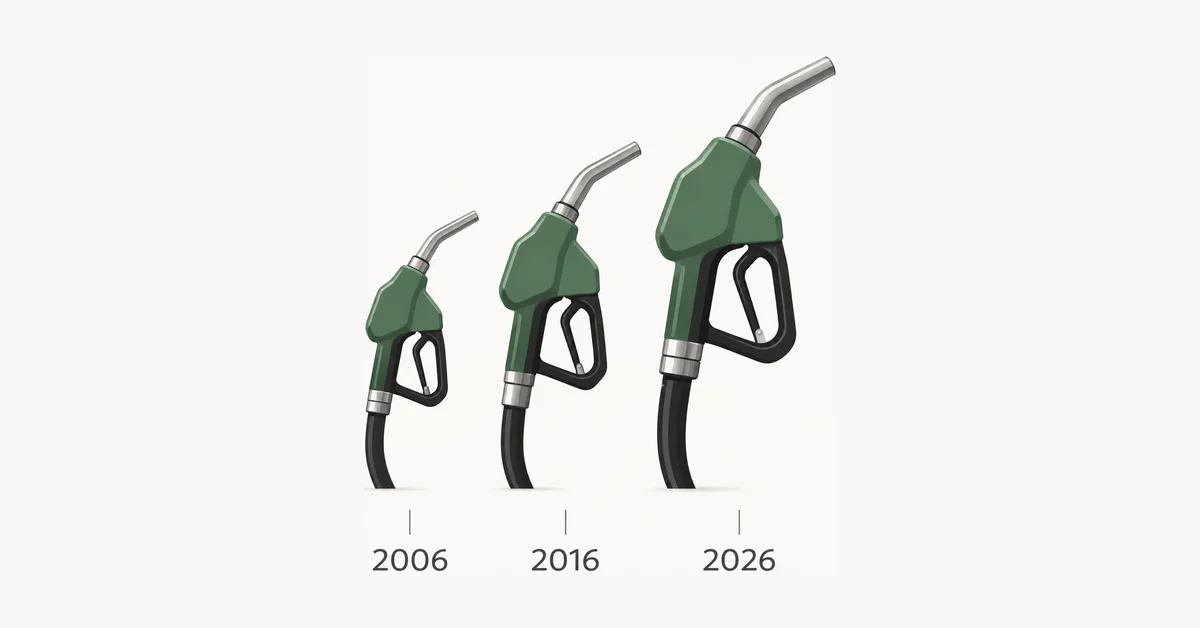
A 50 litre tank of 95 unleaded cost R309.00 in October 2006 and R630.00 in October 2016. From 7 October 2026 it costs R1,512.50. Even after adjusting for inflation, petrol is more expensive today than at any point in that twenty year span.
Nominal price comparisons across decades are close to meaningless, because the rand itself has changed. So this piece does both. First the raw numbers, then what they are worth in today's money, and then the part most people get wrong: what share of the price is tax.
The raw price, three decades apart
| Date | 95 unleaded, inland | 50 litre tank |
|---|---|---|
| 4 October 2006 | R6.18 | R309.00 |
| 5 October 2016 | R12.60 | R630.00 |
| 7 October 2026 | R30.25 | R1,512.50 |
The 2006 figure comes from the Department of Minerals and Energy statement of 29 September 2006. The 2016 figure is from the DMPR media statement for October 2016 and is corroborated by the price history at the Fuels Industry Association of South Africa. The 2026 figure follows the increase confirmed on 5 October 2026.
In plain terms, petrol is 4.9 times more expensive than in 2006 and 2.4 times more expensive than in 2016.
Now adjust for inflation
Using South African consumer price index data, R100 in 2006 is worth roughly R278 today, and R100 in 2016 is worth roughly R154 today. Applying those factors:
| Year | Tank cost, as it was | Tank cost in 2026 rands |
|---|---|---|
| October 2006 | R309.00 | About R860 |
| October 2016 | R630.00 | About R969 |
| October 2026 | R1,512.50 | R1,512.50 |
So in real terms a tank of petrol costs about 76 percent more than in 2006 and about 56 percent more than in 2016. These inflation conversions are our calculation and will shift by a few percent depending on which CPI series you use.
Diesel tells an even starker story. In 2026 rands, 50ppm diesel cost roughly R16.60 a litre in October 2006 and roughly R16.54 in October 2016. It was essentially flat in real terms for an entire decade. It now sits above R32 wholesale. The real price of diesel has roughly doubled in ten years.
The tax question
This is where most commentary goes wrong. The two big levies are the General Fuel Levy and the Road Accident Fund levy. Here is how they have grown.
| Levy, per litre of petrol | October 2006 | October 2026 |
|---|---|---|
| General Fuel Levy (price structure line) | 116.0 c | 429.0 c |
| Road Accident Fund levy | 36.5 c | 225.0 c |
| Combined | 152.5 c | 654.0 c |
The 2006 breakdown is published in the Department of Minerals and Energy statement of 29 September 2006. The 2026 levy figures come from the Central Energy Fund price structure. Note that the 2026 fuel levy line includes the carbon fuel levy, which did not exist in 2006.
In rand terms the levies have grown about 4.2 times. The Road Accident Fund levy alone is up more than six times. Statistics South Africa has made the same point in its own deep dive into the price of fuel, noting that the RAF levy grew far faster than the basic fuel price.
Here is the counterintuitive part. As a share of the pump price, tax has actually fallen:
| Date | Combined levies | Pump price | Tax share |
|---|---|---|---|
| October 2006 | 152.5 c | 618 c | 24.7% |
| October 2016 | 443 c | 1,260 c | 35.2% |
| October 2026 | 654 c | 3,025 c | 21.6% |
The tax burden has not eased. The share has fallen because the imported cost of fuel has risen faster than the levies have. In the low oil price years of the mid 2010s, tax made up more than a third of what you paid. Today the international product price dominates.
For a sense of how the full price structure works, National Treasury published a complete breakdown in a 2015 parliamentary reply, showing the basic fuel price, wholesale margin, dealer margin, service cost recoveries and levies as separate lines.
What was happening in the background
| 2006 | 2016 | 2026 | |
|---|---|---|---|
| Brent crude, annual average | About 65 US dollars | About 44 US dollars | 101 US dollars over the October review period |
| Rand to the dollar | About R6.77 | About R14.68 | R16.21 |
Two forces compound here. The oil price is higher, and the rand buys far less of it. A barrel of Brent cost roughly R441 in 2006. Over the October 2026 review period it cost roughly R1,637. That is our calculation from the averages above.
What this means if you are buying a car
Twenty years of this trend is the real argument for looking at running costs rather than purchase price alone. If you bought a car in 2006 on the assumption that fuel would stay affordable, that assumption cost you.
At R30.25 a litre, a car using 8 litres per 100 km costs R242 per 100 km to run. The same distance in an electric car charged at home, at roughly 15 kWh per 100 km and R3.30 per kWh, costs about R50.
Work out what your own car costs you over a year with our fuel fill up cost calculator, then compare it against charging with our EV versus petrol running cost calculator.
Frequently asked questions
How much did petrol cost in South Africa in 2006?
Inland 95 unleaded cost R6.18 a litre from 4 October 2006, which made a 50 litre tank R309.00.
How much did petrol cost in 2016?
Inland 95 unleaded cost R12.60 a litre from 5 October 2016, which made a 50 litre tank R630.00.
Is petrol more expensive now after inflation?
Yes. In 2026 rands, a 50 litre tank cost about R860 in 2006 and about R969 in 2016, against R1,512.50 today. That is about 76 percent more than 2006 in real terms.
How much of the petrol price is tax?
About 21.6 percent of the October 2026 inland 95 price is the General Fuel Levy and Road Accident Fund levy combined, at 654 cents of 3,025 cents. The share was 24.7 percent in 2006 and 35.2 percent in 2016.
Why has the tax share fallen if levies went up?
Because the international cost of fuel has risen faster than the levies. The levies are 4.2 times higher than in 2006 in rand terms, but the pump price is 4.9 times higher.